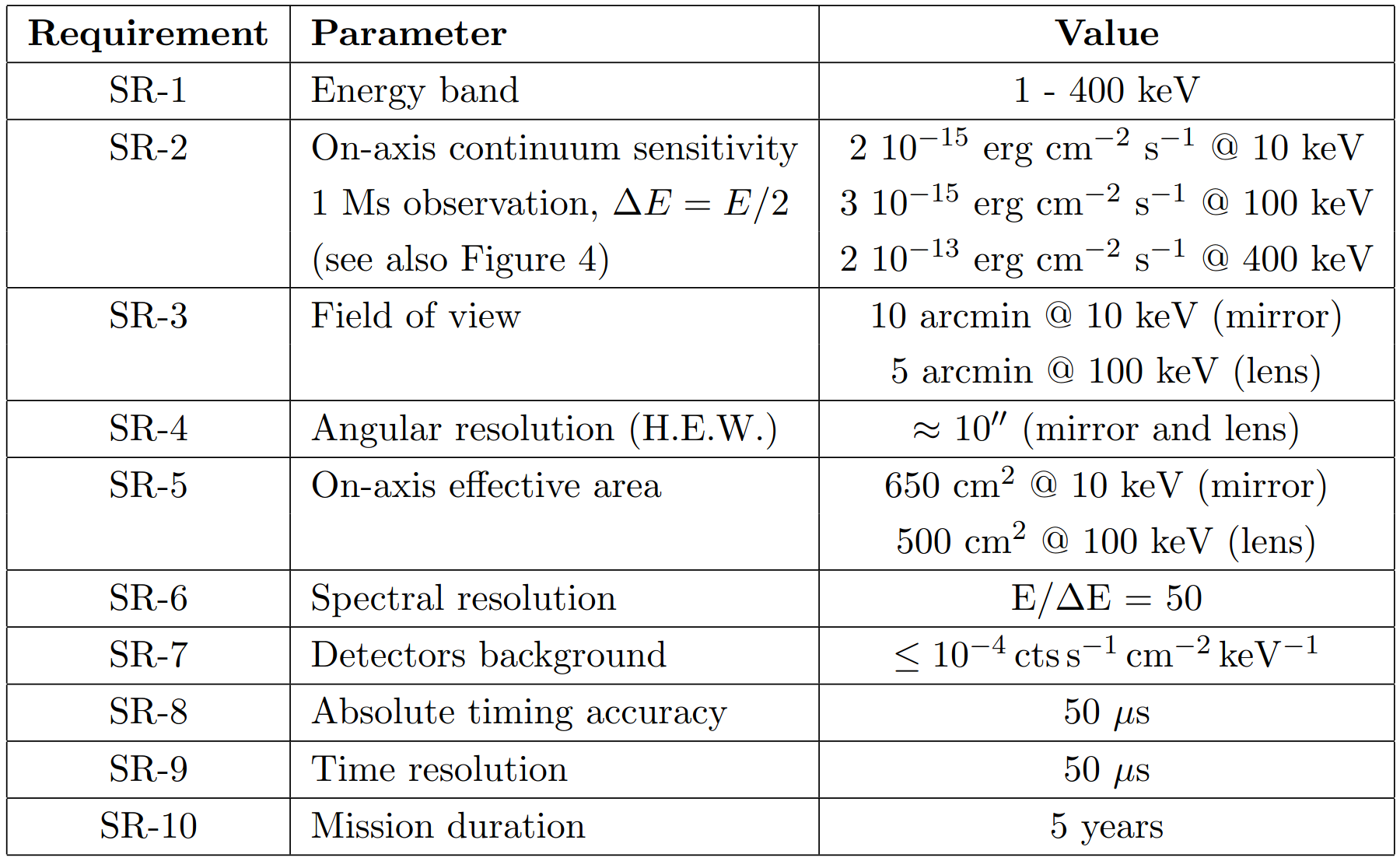
To address these main scientific objectives, the PHEMTO scientific requirements are given in the table below. It is also important to point out that with such characteristics, PHEMTO will address many questions in other astrophysical domains and, without any doubts, many serendipitous objectives and questions which may be opened in the next decades.
Payload elements
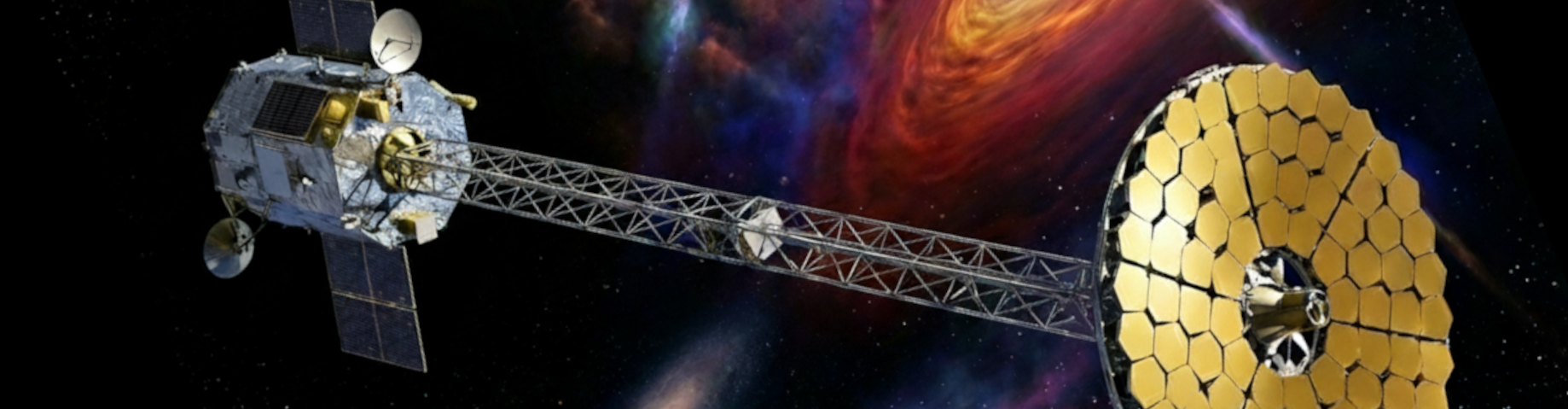
The envisioned technical implementation for the PHEMTO observatory is to have two independent focusing systems looking simultaneously at the same sky. The focal length will be 20 meters. One more efficient at low energy, based on focusing mirrors working in reflection conditions, and the other one at higher energies, based on the Laue lens technique (see [Takahashi, 2005, Frontera et al., 2013]). The mirror optic will be made of Ni-electroformed full shell mirror substrates, leveraging the heritage of XMM-Newton and coated with Pt/C and W/Si multilayers for an effective energy range of 1−80 keV. Laue lenses exploit the crystal diffraction in transmission configuration (Laue geometry) and is made of a large number of crystal tiles in transmission configuration, which are disposed in such a way that they concentrate the incident radiation onto a common focal spot. The mirror will be accommodated within the Laue lens inner radius, which will have an outer radius of 150 cm, joining the two focusing optics into a single unit.
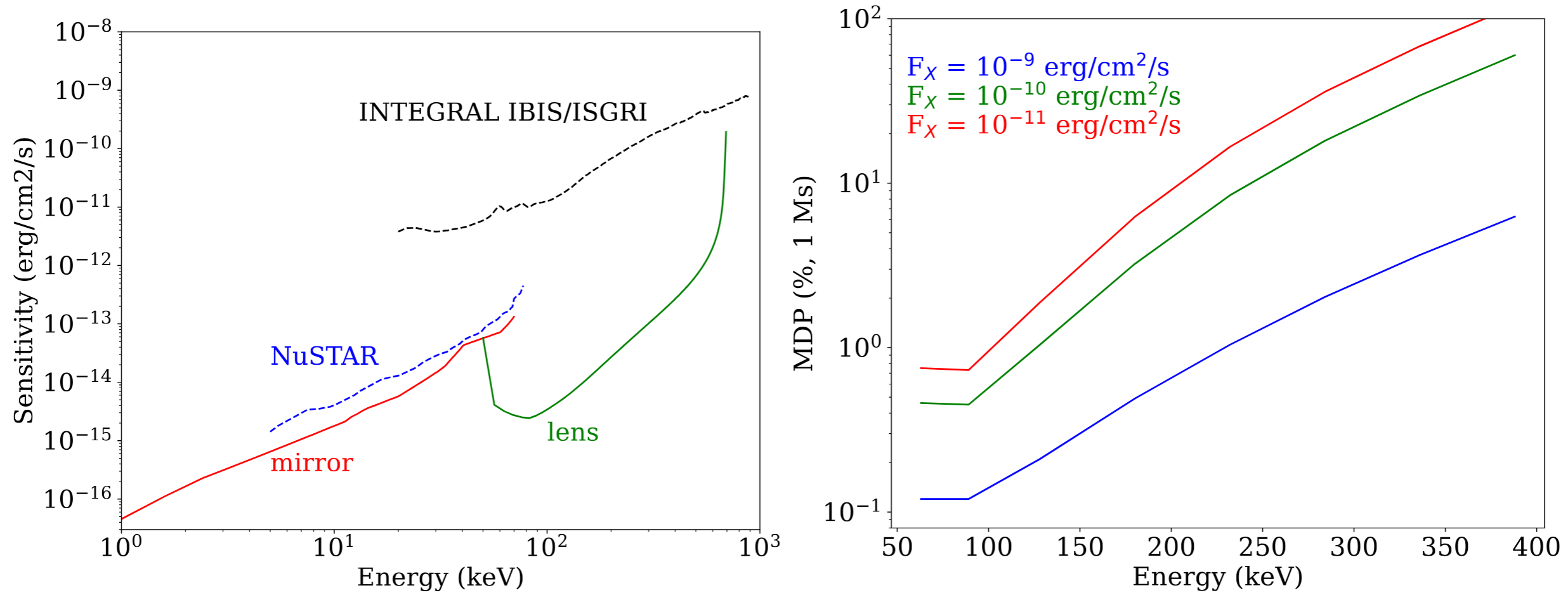
The PHEMTO focal plane (FPA) will be designed to detect focused single photons in the 1−400 keV energy range. To do so, the FPA will be equipped with two superimposed semiconductor-based imaging spectrometers, the LED (Low Energy Detector) and HED (High Energy Detector). Both are embedded into an active and passive shield system (Anticoincidence System, called hereafter AC). LED and HED will measure the interaction position, energy deposit, and arrival time of each incoming X-ray photon. The LED detector will be a Si-based matrix operating from 1 up to 20 keV; the HED will be a CdTe pixelized detector covering the 8 to 400 keV range. Precise timing will be obtained above 4 keV using a fast triggering for the LED. The FPA will be also a Compton Polarimeter, by combining LED/HED coincidence data above 50 keV. A collimator on the FPA will stop all photons outside the mirror’s field of view. AC will allow detecting charged particles of the space environment, avoiding a significant loss of sensitivity due to induced background on LED and HED. The PHEMTO resulting sensitivity is shown in Figure 4.