
The fast shocks of young SuperNova Remnants (SNRs) are efficient particle accelerators and the main sources of Galactic Cosmic Rays (GCRs), as evidenced by the observation of synchrotron emission in the X-ray band. The same type of emission is seen from Pulsar Wind Nebulae (PWNe), bubbles of relativistic particles (mostly pairs) inflated by pulsar winds and interacting with the surrounding medium, forming a relativistic shock which accelerates particles up to PeV energies. Although the basic concepts of diffusive shock acceleration are well understood, many important aspects remain unexplored, such as the maximum energy reached, the amplification of seed magnetic fields, the level of magnetic turbulence, and the magnetic configuration around neutron stars.
The role of the magnetic field in SNRs and PWNe
Particle acceleration and turbulence via the study of the synchrotron emission
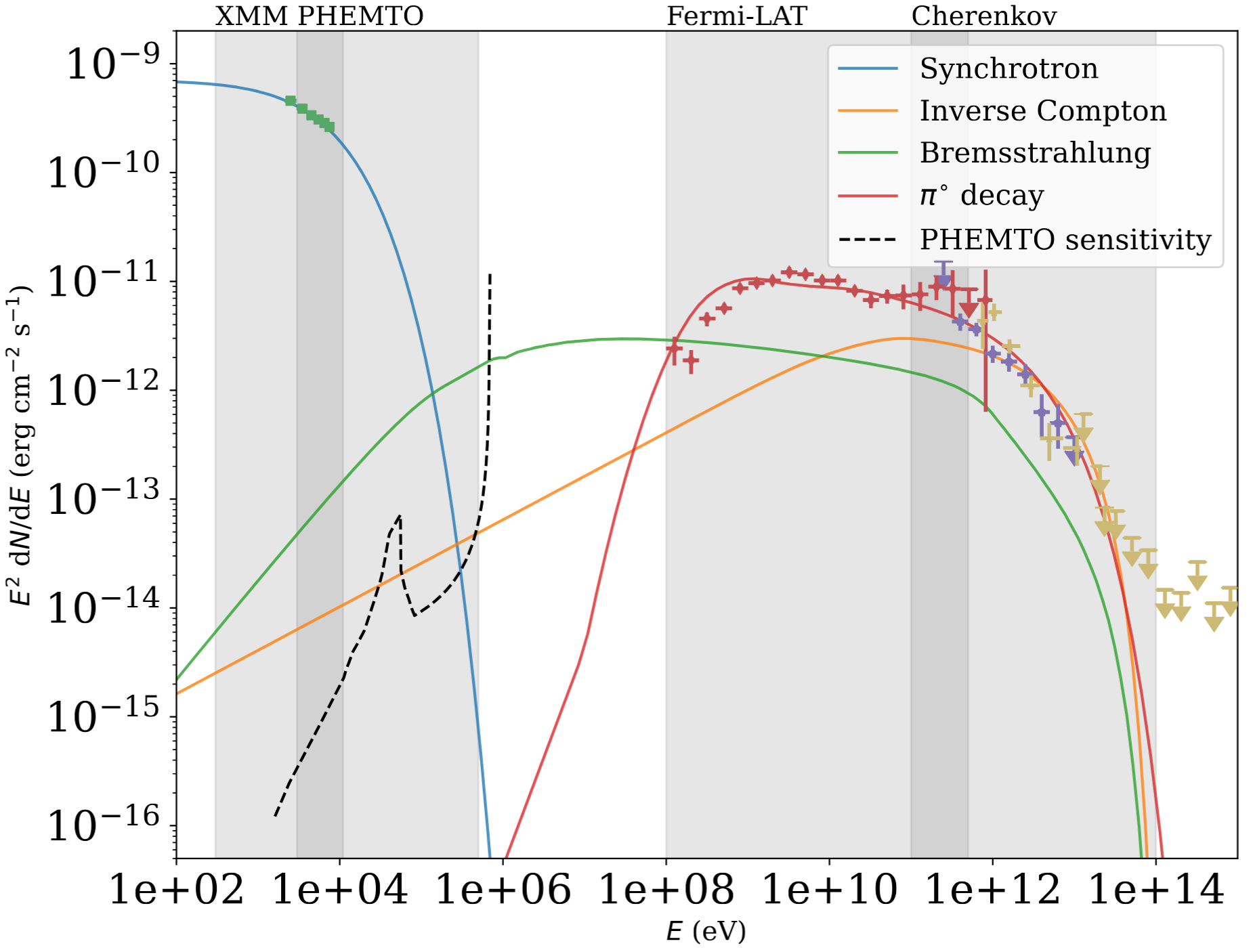
Observations of synchrotron X-rays prove that young supernova remnants accelerate electrons, perhaps to energies of 100 TeV or even higher. Yet the maximum energies these particles can reach and the details of the acceleration mechanism are still unclear. For most young SNRs, the synchrotron spectral cutoff is in the X-ray band and its shape can provide important constraints on the acceleration mechanism, particularly on the diffusion coefficient α (D ∝ Eα). Fig. 1 shows the example of the young SNR Cassiopeia A where the synchrotron cutoff can be fully covered in the PHEMTO energy band. We note that what we observe is the synchrotron radiation and not the particles’ properties directly. The link between the electron population and the bserved photons spectral signature depends on magnetic field configuration (uniform or turbulent) and needs to be constrained simultaneously by polarization measurements. NuSTAR observations have allowed us to probe the high-energy spectrum of the Cassiopeia A SNR (the brightest X-ray SNR) but only up to ∼50 keV and the synchrotron maps remain completely unexplored by focusing imaging instruments in the 50-400 keV band. Using a pixel-by-pixel analysis, IXPE was not able to measure a significant polarization signal [Vink et al., 2022]. Studying individual filaments both spectrally and in polarization, which is required to fully understand the acceleration key questions, was out of reach for NuStar and IXPE due to their energy range. Given PHEMTO sensitivity, several SNRs fainter than CasA (e.g. Tycho, Kepler, SN 1006, Vela Jr, RX J1713-3946, ...) could be studied spatially, spectrally, and in polarization, opening the door to population studies.
Disentangling the hard X-ray emission
The study of the inverse Compton γ-ray emission in SNRs can be used to probe the properties of the electron population and estimate the magnetic field strength by comparison with the X-ray synchrotron emission. In the gamma-rays range, such study is presently limited due to: 1) the emission being a mixture of electrons or hadrons emission (via the π0 process, see Fig. 1), scrambling the link between the photon spectral properties and the electron properties, and 2) the spectral properties of electron population and the estimate of the magnetic field strength can only be obtained at the level of the entire SNR, due to the present hard X-ray telescope limited angular resolution. The 1-400 keV PHEMTO energy band, combined with high angular resolution has the unique capability to resolve and measure the full spectral properties of the electron population.
Magnetic configuration in pulsar wind nebulae
X-ray images of of many young PWNe reveal axisymmetric features with a torus and jet, like in the Vela and Crab nebulae. The torus can be explained by an anisotropic pulsar wind energy flux (higher in the equatorial plane) interacting with a toroidal magnetic field which is compressed and accelerates particles. However, to produce jets, an additional magnetic component is necessary, either a poloidal or disordered (isotropic) field. The synchrotron emissivity in PWNe is sensitive to both the magnetic field perpendicular to the fluid motion and the flow speed (via Doppler boosting), the latter making it difficult to constrain the field structure. Only resolved PHEMTO X-ray polarization maps would allow to lift the degeneracy between Doppler boosting and magnetic field configuration closest to the acceleration site [Bucciantini et al., 2017].
Magnetars as powerful Cosmic Accelerators
Magnetars are believed to be magnetically powered neutron stars (NS) whose magnetic field is several orders of magnitude larger than regular radio pulsars (B∼1013−15G). They have been originally invoked to explain the phenomenology of Anomalous X-ray Pulsars (AXPs) and Soft-Gamma Repeaters (SGRs). These sources can be persistent or transient; some of them showing short time variability and so-called giant flares Magnetars are nowadays believed to play a crucial role in a much wider range of astrophysical phenomena, from ultra-luminous X-ray sources (ULXs) and fast radio bursts (FRBs) to (cosmological) gamma-ray bursts (GRBs).
Physics of the magnetar high-energy emission
Many magnetars exhibit high-energy hard tails that extend up to several hundreds of keV, either persistently or following transient events. The nature of this emission remains unclear in terms of radiation and acceleration processes. A sensitive spectro-polarimeter like PHEMTO can nail down these magnetospheric properties, reveal the magnetic field topology, locate the emission region(s) in the magnetosphere and map for the very first time the particle acceleration along closed field lines and quantify its attenuation due to photon splitting and pair production in high B fields.
System inclination and GW emission
The application of models for the non-thermal magnetar emission to current data is also plagued by the poor knowledge of source inclination and viewing geometry. As the expected polarization signature depends significantly on the geometry, measurements with PHEMTO will be crucial to reconstruct the highly debated system inclination, linked to the way in which the kick is imparted to the proto neutron star during its formation and acceleration. This is key to quantify the contribution of magnetars to gravitational radiation (GW) emission, since orthogonal spin-velocity configurations will be efficient GW sources.