Cosmic X-ray background
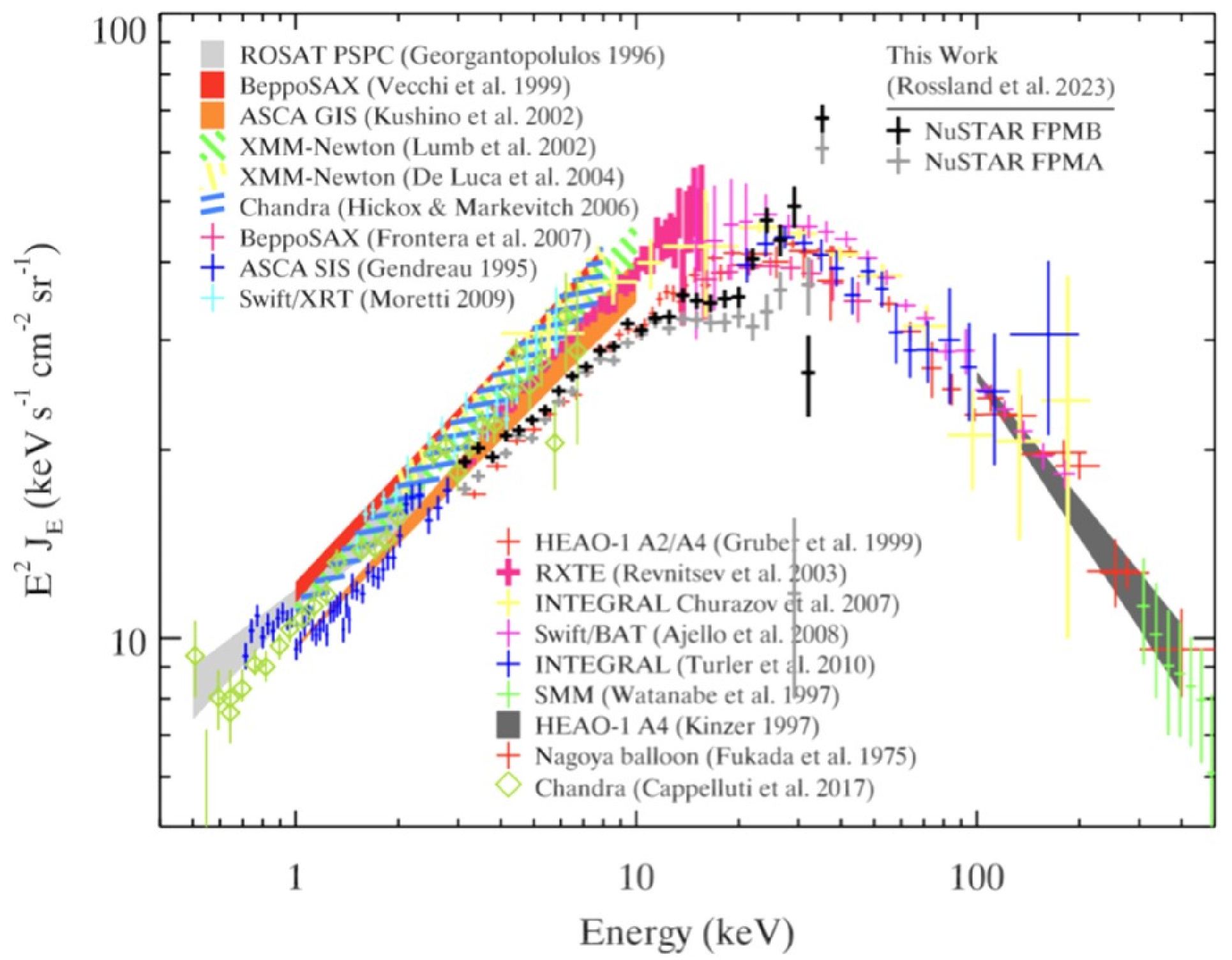
At hard X-ray energies (> 10 keV), the CXB can be almost entirely traced to emission produced by accretion onto SMBHs. AGN of different types over a wide range of redshifts contribute to the CXB emission, tracing the accretion history of the Universe. For this reason, the spectral shape and overall flux of the CXB plays a crucial role in constraining the various populations of AGN, especially that of most difficult to detect, the Compton-thick (CT) those absorbed by a column density in excess of 1024 at/cm2. Recently, NuSTAR has been able to account for ∼40% of the X-ray sources responsible for the CXB in the ∼8-24 keV energy band [Rossland et al., 2023]. However, NuSTAR was not able to constrain the position of the CXB spectrum peak, confirming only that the peak lies above 20 keV. Figure 3 taken from [Rossland et al., 2023], shows the energy spectrum of the cosmic X-ray background as measured by all previous instruments from HEAO-1 to NuSTAR. As can be seen from the figure, NuSTAR measurements between ∼ 25 and 40 keV (i.e. the peak of the CXB spectrum) are poorly constrained: this is the energy band where PHEMTO will greatly contribute. Taking these data into account, we have computed that, with an observing time of 500 ks, PHEMTO will resolve ∼60% of the CXB (compared to a resolved fraction of ∼ 5% in current Swift and INTEGRAL surveys). This fraction, easily achievable with PHEMTO, is comparable or even larger than that already resolved by XMM and Chandra between 5 and 10 keV, and still larger by a factor of around 2 compared to NuSTAR. In a deep 1 Ms exposure, our simulations show that PHEMTO would be able to measure the X-ray spectral characteristics of the faintest detectable sources up to z ≃ 3 and with luminosity in the 2−10 keV energy range less than a few 1044 erg s−1, separating unabsorbed, Compton thin and CT objects with high significance, and recovering the intrinsic absorption with less than 20% uncertainty for Compton thin objects.
Obscured accreting AGN
Thanks to the PHEMTO unprecedented sensitivity reached at high energies (∼10−15 up to 10 keV), heavily absorbed AGN will be detected not only in the local Universe but also likely up to z∼ 1. Current X-ray spectra of AGN at z∼1 are rather poorly known, the uncertainties on heir column densities are large and some of them may be even CT. High-energy PHEMTO spectra will easily distinguish between Compton-thin and Compton-thick AGN. For a moderately bright (LX = 1044 erg s−1) Compton thick AGN at redshift z=1, the absorbing column density can be determined with an error of 25% within a 100 ks observation. Moreover, by targeting candidates from previous surveys (XMM-Newton, Chandra, NuSTAR, INTEGRAL) will make possible the detailed study of their broad band spectrum in the 1−400 keV for the first time. A further crucial issue that PHEMTO can address is the elusive class of compact obscured nuclei (CONs) which are strong mid-infrared emitters selected in the 14 μm band [Falstad et al. 2021]. The mechanisms that drive the buildup of this nuclear obscuration are still unclear and great efforts are been made in order to understand whether CONs harbor CT AGN. PHEMTO will be able to detect some candidates in the hard X-ray band and help in unveiling their nature. The combination of X-ray and infrared information can be used to measure the number density of highly obscured QSOs. By joining this sample to those obtained from the surveys, we will be able to determine the evolution of the obscured AGN population, a step forward in completing the census of SMBH through Cosmic time.