Nuclear production in SNIa
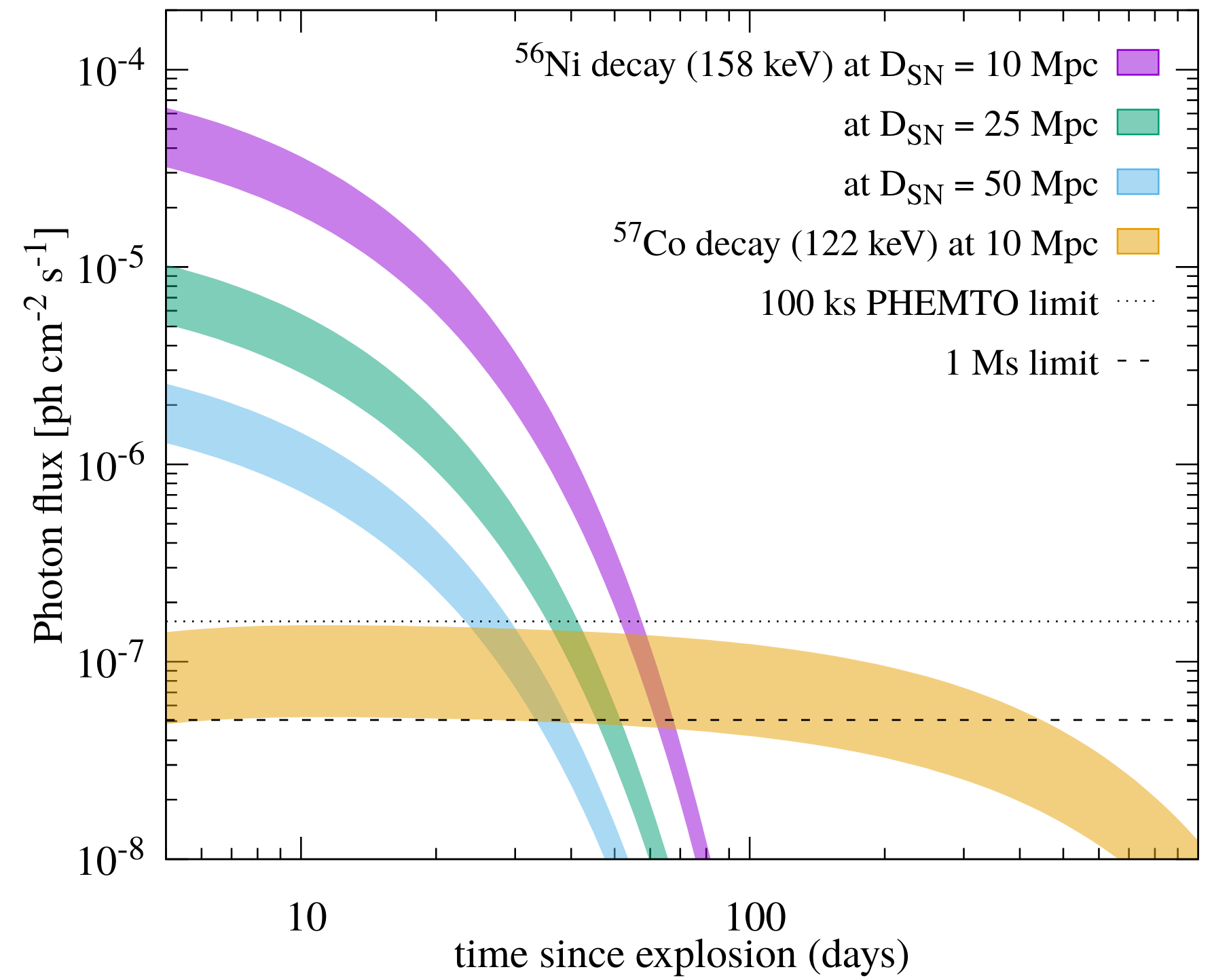
The optical light curve of supernovae (SNe) is powered by the decay of radionuclides synthesized at the nuclear burning front of SNe. Type Ia SNe, in particular, are the main source of Fe in the Universe, from the decay of their main product 56Ni to 56Co and 56Fe. The resulting nuclear lines and high-energy continuum emission provide the most direct measurement of the nickel mass of SNe Ia, an essential constraint of the progenitor channel of SN Ia [Maeda et al., 2012]. So far, only the nearest type Ia SN2014J has been detected via nuclear lines with INTEGRAL [Diehl et al., 2014]. As the 3D nature of the explosion and viewing angle affect the line detection and measurement of Ni production [Summa et al., 2013], a larger sample of SN Ia is needed. For this, PHEMTO’s three order of magnitude sensitivity improvement with respect to INTEGRAL IBIS will dramatically increase the detection horizon: At an anticipated line sensitivity of 2 × 10⁻⁷ ph cm−2 s−1 for 100 ks, the 158 keV 56Ni →56Co decay line can be observed routinely for SNe Ia within 50 Mpc (Fig. 2), or about one event per month. Furthermore, the mass of another nickel isotope (57Ni) can be observed from the 122 keV line of 57Co → 57Fe decay (t1/2 = 272 d). The ratio 57Ni/56Ni is sensitive to the physical conditions (central density and metallicity) of the exploding white dwarf [Leung and Nomoto, 2018]. For a SN Ia nearby (< 10 Mpc, about one event per mission lifetime), we will have the possibility to obtain the first ever direct measurement of 57Ni yield (Fig. 2). Coupled with high spectral resolution from NewAthena to measure the yields of 55Fe and neutron-rich species (Cr, Mn), we will be able to fully characterize the progenitor channel of type Ia SNe.
Probing stellar explosion with 44Ti
In the core-collapse (CC) SNe of massive stars, 44Ti is produced closest to the mass cut, the region separating material falling back on the newly-born neutron star from the ejecta. Its yield and the ratio 44Ti/56Ni are very sensitive to physical conditions. Since the decay of 44Ti to 44Sc (half-life of 59.2 yr) emits two lines at 68 and 78 keV, its yield can be measured in young supernova remnants up to a few hundred years old. The 3D distribution of this isotope can be revealed by resolving the emission both spatially (via imaging) and spectrally (via spectroscopy). Such measurements have been possible only for Cas A and SN1987A [Grefenstette et al., 2014, Boggs et al., 2015], but still suffer from large uncertainties. A jump in sensitivity by up to two orders of magnitude is needed to reap the benefits 44Ti can offer. It will be possible to compare the 3D dynamics of that element with that of iron, the decay product of 56Ni to constrain important aspects of the CC SN engine like the need for rapid rotation and/or jets [Wongwathanarat et al., 2017]. With PHEMTO sensitivity the 44Ti lines will be detectable for older Galactic CC SNRs such as Kes 75, 3C58, G21.5−0.9, and the Crab, for 44Ti yields of (0.5 − 2) × 10−4 M⊙, thus offering new constraints on nucleosynthesis and explosion models [Chieffi and Limongi, 2017]. Since these remnants all contain pulsars or magnetars, the relative motion of titanium produced in the core of the star can be compared with that of the compact object to investigate the origin of neutron star kicks [Wongwathanarat et al., 2017].