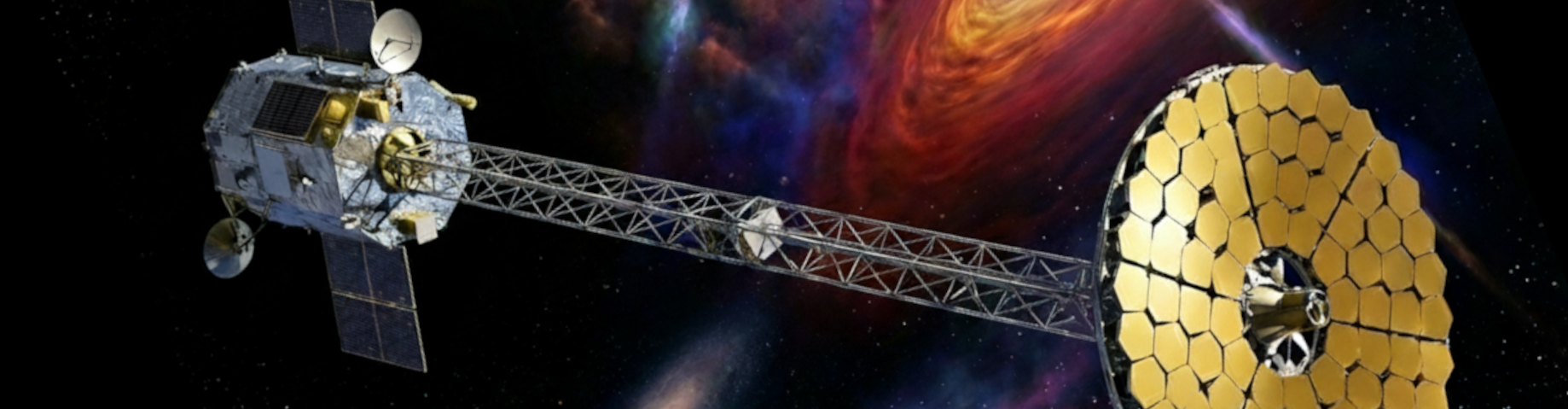
Due to its long focal length, 20 meters, the PHEMTO mission will require two spacecrafts in formation flight, one with the lens + mirror system and the other hosting the detector payload. Another cheaper option would be to use an NuSTAR-like extended boom (discussions are on-going with our Japanese colleagues to look if this boom could be provided by JAXA). To keep a low background, the mission should be launched on a highly eccentric orbit around Earth, of the XMM type. The expected mission duration is 5 years.
Part of the estimated resources and constraints for the formation flight are derived and updated from the similar M3 proposal COSPIX. Estimated mass includes a total mirror mass of 510 kg (mirror: 270 kg and lens: 240 kg), including a 20% margin. These numbers are also derived from last LAUE lens R&D studies. Studies for the COSPIX mission lead us to a detector payload around 170 kg with margins, which should be similar for PHEMTO. Conservatively assuming two service modules of around 800 kg for a total dry mass of 1480 kg. Estimating 250 kg for the adapter and propellant for the two satellites gives a total wet mass of 1730 kg, well within the constraints of the Ariane 6.2 launcher. The peak payload power requirement is estimated to be around 500 W, and the envisaged scientific data rate is around 2 Mbps.
On the mirror spacecraft, the mirror main cylinder is placed inside the lens inner radius. The top floor will be used to carry the RF antennas dedicated to the formation flying control. On the detector spacecraft, the payload base plate must ensure the interface between the top floor and the payload assemblies (collimator and focal plane mainly). The Collimator tube is mounted in the center of a structure called Collimator Tower. As in COSPIX, this structure may support in addition the RF antennas dedicated to the formation flying control and the passive radiator used to cool down the detectors.